In short
The Supreme Court of Canada is the country’s final court of appeal. It has nine judges, and by law at least three must come from Quebec. In most cases you need the Court’s permission to appeal, called leave to appeal, and it grants that only for issues of public importance. Governments can also ask it for an opinion on a legal question, called a reference. That’s how it ruled on whether Quebec could leave Canada.
The details
A short history
- 1875: Parliament created the Supreme Court, using its power under section 101 of the Constitution Act, 1867.
- Until 1949, it wasn’t actually the last word. Cases could still be appealed to the Judicial Committee of the Privy Council in London. Appeals in criminal cases to London ended in 1933, and all remaining appeals ended in 1949.
- Since 1949, the Supreme Court has been Canada’s final court of appeal.
Did you know?
A well-known example of the old system: in the Persons Case (1929), the Privy Council overturned the Supreme Court and ruled that women were “persons” who could be appointed to the Senate.
Who sits on it
The Supreme Court Act sets the Court’s makeup:
- Nine judges: the Chief Justice of Canada and eight others, called puisne (pronounced “puny”) judges (s. 4(1)).
- Who qualifies: a current or former judge of a provincial superior court, or a lawyer with at least 10 years at the bar of a province (s. 5).
- Quebec seats: at least three judges must come from Quebec’s Court of Appeal, its Superior Court, or the Quebec bar (s. 6). This makes sure the Court always has judges trained in Quebec’s civil law. See Common law and civil law.
- Retirement: judges must retire at 75 (s. 9(2)).
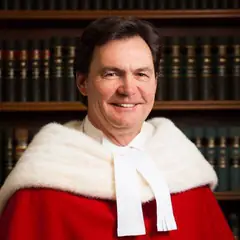
Chief Justice of Canada
Chief Justice since 2017; on the Court since 2012
Turns 75 in 2032

Justice since 2026
The Chief Justice first, then the other judges by date of appointment. Judges must retire at 75. Source: Wikidata, corrected against the Supreme Court of Canada's list of judges, as of November 13, 2026. Photos: Wikimedia Commons where a freely licensed one exists; see Credits.
By custom, not law, the other six seats are usually shared out regionally: three from Ontario, two from the western provinces or the North, and one from Atlantic Canada.
In 2014, the Court ruled that its own makeup, including the Quebec seats, is protected by the Constitution. Parliament can’t change it alone. Changes would need the agreement of Parliament and every province (Reference re Supreme Court Act, ss. 5 and 6, 2014).
Judges are appointed by the Governor General on the Prime Minister’s choice. See Judges for how candidates are found.
How a case gets there
The Supreme Court doesn’t hold trials. It hears appeals from the provincial and territorial courts of appeal, the Federal Court of Appeal and the Court Martial Appeal Court.
- Leave to appeal. For most cases, a panel of the Court first decides whether to hear the appeal at all. It grants leave when a case raises an issue of public importance (s. 40(1)), for example a major constitutional question, or when courts of appeal in different provinces disagree. The Court usually doesn’t give reasons for granting or refusing leave. Only a small share of applications are granted. In 2025, the judges considered 474 applications and granted 35, about 7%.
- Appeals as of right. In a few situations, no permission is needed. One example is certain criminal cases where a judge of the court of appeal dissented on a point of law.
Appeals are heard by at least five judges, and most often by seven or nine. There are no witnesses or juries. The judges read written arguments, hear lawyers argue, and usually issue written reasons, sometimes months later. Hearings can be in English or French, and judgments are published in both.
References: answering governments’ questions
Normally a court only decides real disputes between parties. A reference is the exception: a government asks a court for its opinion on a legal question.
- The federal cabinet can refer important questions of law or fact directly to the Supreme Court, for example about the meaning of the Constitution or whether a law is constitutional (s. 53 of the Supreme Court Act).
- Provincial governments can’t go straight to the Supreme Court. They refer questions to their own court of appeal, and its opinion can then be appealed to the Supreme Court without needing leave.
Some major references:
| Year | Reference | The question, roughly |
|---|---|---|
| 1981 | Patriation Reference | Could Ottawa ask the UK to change Canada’s Constitution without the provinces’ consent? See Patriation. |
| 1998 | Secession Reference | Could Quebec leave Canada on its own? The Court said no, not unilaterally under the Constitution. But if a clear majority of Quebecers voted for secession on a clear question, the rest of Canada would have a duty to negotiate. |
| 2004 | Same-Sex Marriage Reference | Could Parliament define marriage to include same-sex couples? The Court said yes. |
| 2014 | Senate Reform Reference | Could Parliament alone create Senate elections or term limits? The Court said no; that would need provincial consent. |
The Secession Reference is also summarized on the landmark cases page.
Strictly speaking, a reference opinion is advisory. In practice, governments have always treated them as binding.
Why its decisions matter so much
Every other court in Canada must follow the Supreme Court’s decisions. When it rules that a law is unconstitutional, that ruling applies across the country. This is how the Court shapes the Charter: most of what the Charter means in practice comes from its decisions.
Sources
- Supreme Court Act: s. 4(1) (nine judges), s. 5 (qualifications), s. 6 (three from Quebec), s. 9(2) (retirement at 75), s. 40(1) (leave to appeal), s. 53 (references)
- Supreme Court of Canada: judicial work: leave to appeal, appeals as of right, references, panel sizes, bilingualism
- Supreme Court of Canada: meet our judges: the regional distribution of seats is a tradition, not law
- Supreme Court of Canada: statistical summary 2016 to 2025: leave applications submitted to the Court and granted in 2025
- Constitution Act, 1867: s. 101 (power to create a general court of appeal)
- Reference re Secession of Quebec, [1998] 2 S.C.R. 217
- The judicial structure (Department of Justice)