Skip to content
True North Explained

Search the site

    Territory

    Nunavut

    Canada's newest territory, created in 1999 through an Inuit land claim, governed by consensus and working in Inuktut.

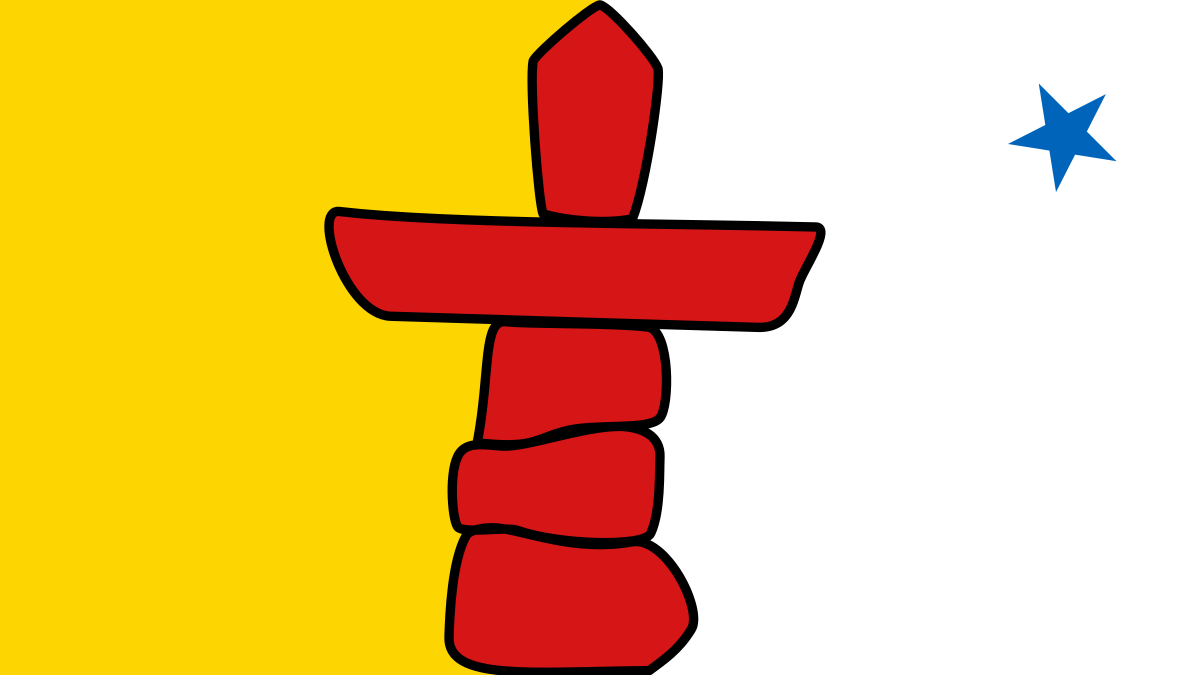
    Flag of Nunavut
    John Main
    PremierJohn MainNo party: consensus government

    At a glance

    Capital Iqaluit
    Became a territory 1999 (separated from the Northwest Territories)
    Legislature Legislative Assembly of Nunavut (one chamber)
    Seats 22
    The federal representative Commissioner
    Head of government Premier

    As of 2026: The Legislative Assembly has 22 members, one for each constituency.

    In numbers

    Population and seats

    Nunavut in the House of Commons

    Nunavut has 0.10% of Canada's people and one of the 343 seats in the House of Commons (0.29%); its one MP represents about 43,100 people, 65% fewer than the national average of 122,000.

    Share of Canada

    • People0.10%
    • House seats0.29%

    People per MP

    • Nunavut43,091
    • Canada121,861

    Each territory has one seat, whatever its population. Seats were shared out in 2022 using 2021 population estimates; the population shown is the latest estimate, so the shares have drifted a little since. How seats are shared out.

    Show the data
    NunavutCanada
    Population, July 1, 202643,09141,798,407
    Share of Canada's population0.10%100%
    Seats in the House of Commons1343
    Share of seats0.29%100%
    Seats by population alone0.4343
    People per MP43,091121,861
    "Seats by population alone" shares all 343 seats in proportion to today's population, with no rounding or guarantees.
    Sources: Statistics Canada, Table 17-10-0009-01 (July 1, 2026); Elections Canada, 2022 allocation of seats

    Nunavut's population, 1991 to 2026

    Nunavut's population grew from 22,200 in 1991 to 43,100 in 2026, and its share of Canada's rose from 0.08% to 0.10%.

    Population of Nunavut, 1991 to 2026Nunavut's population grew from 22,200 in 1991 to 43,100 in 2026, and its share of Canada's rose from 0.08% to 0.10%.20K40K60K20002020

    Estimates for today's boundaries start in 1991, so the line starts there.

    Show the data
    July 1PopulationShare of Canada
    202643,0910.10%
    202542,1080.10%
    202441,4440.10%
    202340,9390.10%
    202240,6040.10%
    202140,0860.10%
    202039,4790.10%
    201938,8390.10%
    201838,3220.10%
    201737,6560.10%
    201636,9790.10%
    201536,4900.10%
    201435,9660.10%
    201335,3300.10%
    201234,6580.10%
    201134,1850.10%
    201033,3590.10%
    200932,6040.10%
    200831,8980.10%
    200731,3940.10%
    200630,8180.09%
    200530,3280.09%
    200429,8360.09%
    200329,3010.09%
    200228,8170.09%
    200128,1340.09%
    200027,4980.09%
    199926,8200.09%
    199826,3730.09%
    199725,8840.09%
    199625,6690.09%
    199524,9780.09%
    199424,4070.08%
    199323,5590.08%
    199222,8830.08%
    199122,1540.08%
    Statistics Canada's July 1 population estimates. Estimates before 1971 are rounded to the nearest thousand.
    Source: Statistics Canada, Table 17-10-0009-01 (July 1 estimates)

    2025 federal election

    Nunavut: seats and votes, 2025

    Nunavut's one seat went to the NDP, who won 37.3% of the vote, 0.5 points ahead of the Liberals.

    • Share of seats
    • Share of the vote
    NDP1 seat37.3%
    Liberal0 seats36.7%
    Conservative0 seats26.0%

    Turnout was 35.4% of 21,912 electors. Nunavut is one riding, Nunavut. See its candidates in the ridings explorer.

    Show the data
    PartyVotesShare of the voteSeatsShare of seatsCandidates
    New Democratic Party2,85337.3%1100.0%1
    Liberal Party of Canada2,81236.7%00.0%1
    Conservative Party of Canada1,99226.0%00.0%1
    Total7,657100%1100%
    Valid votes. "Others" groups every other party and independent candidate.
    Source: Elections Canada, official voting results, 45th general election (April 28, 2025)

    Federal transfers

    Major transfers per person, 2026-27

    In 2026-27, Nunavut gets about $58,000 per person in major federal transfers, $56,100 of it through Territorial Formula Financing; territories don't receive equalization, and the average across the provinces is $2,440.

    • Canada Health Transfer
    • Canada Social Transfer
    • Equalization
    • Territorial Formula Financing
    • Nunavut
      $57,952
    • Northwest Territories
      $42,362
    • Yukon
      $34,020
    • Average, all provinces
      $2,440

    Dollars per resident in fiscal year 2026-27, cash payments, using the population Finance Canada uses to share out the transfers. Territories are compared with each other; their transfers per person are on a different scale from the provinces'. How the transfers work.

    Show the data
    TerritoryHealthSocialEqualizationTFFTotal
    Nunavut$1,381$429—$56,143$57,952
    Northwest Territories$1,362$426—$40,574$42,362
    Yukon$1,367$429—$32,224$34,020
    Average, all provinces$1,366$427$648—$2,440
    Dollars per person, fiscal year 2026-27. Nunavut's payments in millions: health 58, social 18, Territorial Formula Financing 2,358.
    Source: Finance Canada, Historical Transfer Tables (2026-27 allocations and population)

    Territories aren't part of equalization. They receive Territorial Formula Financing instead (in the chart above). This site's transfer data has Territorial Formula Financing for 2026-27 only, so there is no history to chart here.

    Premiers

    Nunavut's premiers since 1999

    Nunavut has had seven premiers and government leaders since 1999, none of them leading a party government; today's government works by consensus.

    • Non-partisan

    Each block is one premier's time in office, coloured by their party's family, from 1999 to today.

    Compare all 13 provinces and territories.

    Show the data
    PremierPartyFromTo
    Paul OkalikConsensus governmentApril 1, 1999Nov. 19, 2008
    Eva AariakConsensus governmentNov. 19, 2008Nov. 19, 2013
    Peter TaptunaConsensus governmentNov. 19, 2013Nov. 21, 2017
    Paul QuassaConsensus governmentNov. 21, 2017June 14, 2018
    Joe SavikataaqConsensus governmentJune 14, 2018Nov. 19, 2021
    P.J. AkeeagokConsensus governmentNov. 19, 2021Nov. 20, 2025
    John MainConsensus governmentNov. 20, 2025In office
    Party families: Non-partisan: Consensus government, and the years before party lines formed. Data fetched November 13, 2026.
    Sources: Wikidata, premiers of each province and territory (CC0); Wikipedia, lists of premiers and their articles (CC BY-SA 4.0)

    Treaty areas

    Treaty areas in Nunavut

    Six treaty areas overlap Nunavut, one historic and five modern; together they cover almost all of its land.

    • Historic treaty
    • Modern treaty
    Treaty areas overlapping Nunavut

    Treaty areas as mapped by Crown–Indigenous Relations and Northern Affairs Canada. The data doesn't say which province each is in, so this site works it out by overlaying the areas on the province's boundary; the shares are approximate, and add up to more than the total because some areas overlap. Left out because they only touch the border: Eeyou Marine Region Land Claims Agreement. All treaty areas in Canada.

    Show the data
    TreatyTypeYearsShare of Nunavut's landArea in Nunavut, km²Parties
    Nunavut AgreementModern treaty1993almost all1,996,800The Inuit of the Nunavut Settlement Area and Canada
    Treaty 11Historic treaty19212%48,900Dene First Nations of the Mackenzie Valley, and the Crown (Canada)
    Tłı̨chǫ AgreementModern treaty2005 (signed 2003)less than 1%12,700The Tłı̨chǫ, the Northwest Territories and Canada
    Nunavik Inuit Land Claims AgreementModern treaty2008 (signed 2006)less than 1%6,100The Inuit of Nunavik and Canada
    Délı̨nę Final Self-Government AgreementModern treaty2016 (signed 2015)less than 1%3,600The Délı̨nę First Nation and Délı̨nę Land Corporation, the Northwest Territories and Canada
    Sahtu Dene and Metis Comprehensive Land Claim AgreementModern treaty1994 (signed 1993)less than 1%2,100The Sahtu Dene and Métis and Canada
    Areas are estimates from sampling the boundaries, rounded to the nearest 100 km². Nunavut covers about 2,010,000 km² of land on the same map; almost all of it is in at least one treaty area.
    Sources: Crown–Indigenous Relations and Northern Affairs Canada, Historic treaties; Modern treaties; Statistics Canada, province boundaries

    How it’s governed

    Nunavut is a territory, so its powers come from a federal law, the Nunavut Act, rather than from the Constitution. See Why territories aren’t provinces.

    • The Commissioner is appointed by the federal cabinet and does the formal jobs a Lieutenant Governor does in a province, such as giving assent to laws. The Nunavut Act says the Commissioner must follow written instructions from the federal cabinet or the federal minister. In practice the role is largely ceremonial, and the Commissioner acts on the advice of Nunavut’s elected government.
    • The Legislature is the Commissioner plus the Legislative Assembly, whose 22 MLAs pass Nunavut’s laws.
    • The Premier leads the government, but is chosen by the MLAs, not by a party.

    What makes it different

    Born from a land claim

    Nunavut means “our land” in Inuktitut. It exists because of the Nunavut Agreement (formerly the Nunavut Land Claims Agreement), a modern treaty signed in 1993 between the Inuit of the eastern Arctic and the Crown. In it, Inuit gave up claims to Aboriginal title over the region in exchange for defined rights, including:

    • ownership of certain lands and a share of resource royalties,
    • harvesting (hunting and fishing) rights,
    • a say in managing land, wildlife and the environment through co-management boards,
    • a commitment to create a new territory.

    Parliament passed the Nunavut Act the same year, and on April 1, 1999 the eastern part of the Northwest Territories became Nunavut. The agreement is a treaty protected by section 35 of the Constitution. Nunavut Tunngavik Incorporated (NTI) represents Inuit in making sure it is carried out. See Treaties.

    A public government in an Inuit homeland

    Most Nunavummiut (people of Nunavut) are Inuit, about 84% in the 2021 census. But the Government of Nunavut is a public government: it serves everyone who lives there, and anyone eligible can vote and run for office, whatever their background. This is different from Indigenous self-government, where a First Nation or Inuit government serves its own members. Inuit interests are protected through the land claim and NTI rather than through special rules for who can vote.

    The government also tries to reflect Inuit Qaujimajatuqangit, a term usually translated as Inuit traditional knowledge and values, in how it works.

    Consensus government: no parties

    Like the Northwest Territories, Nunavut has no political parties in its legislature. Everyone runs as an independent.

    1. After an election, the 22 MLAs meet in a special session, the Nunavut Leadership Forum.
    2. They choose the Premier and the cabinet by secret ballot.
    3. The Premier assigns ministers their departments.
    4. The MLAs outside cabinet, the Regular Members, act as an unofficial opposition. By convention they outnumber cabinet.

    Supporters say this fits Inuit traditions of reaching decisions together. Critics say voters can’t choose a government’s direction at the ballot box, and some Nunavummiut have called for party politics. See Northwest Territories for the same model.

    Languages: Inuktut first

    Under Nunavut’s Official Languages Act, the official languages are Inuktut (the Inuit language), English and French. Inuktut covers Inuktitut and Inuinnaqtun. A separate law, the Inuktut Protection Act (called the Inuit Language Protection Act until 2025), promotes its use in schools, workplaces and government services. The Legislative Assembly passed both Acts in 2008. Legislative debates take place in Inuktut as well as English, with interpretation.

    Devolution: still in progress

    Unlike Yukon and the Northwest Territories, Nunavut does not yet manage its own public lands and resources. On January 18, 2024, Canada, the Government of Nunavut and NTI signed the Nunavut Lands and Resources Devolution Agreement. After a transition period, administration and control of Crown lands and resources is set to pass to Nunavut on April 1, 2027.

    As of 2026: Devolution has been agreed but not yet completed. The transfer is scheduled for April 1, 2027.

    Courts

    Nunavut’s court system is unlike anywhere else in Canada.

    Court What it does
    Court of Appeal of Nunavut Hears appeals. Its judges come from the Nunavut Court of Justice and from the courts of Alberta, the Northwest Territories and Yukon.
    Nunavut Court of Justice A single-level trial court. It is both the superior court and the territorial court, so one court hears everything from minor offences to murder trials and divorces.
    Justices of the peace Community members who handle minor matters, especially in small communities.

    Everywhere else, trials are split between a provincial or territorial court and a superior court. Nunavut merged them because it has 25 small communities spread over a fifth of Canada’s land area, and one court that travels on circuit is simpler for people to reach. See the court structure.

    Local government

    Nunavut has 25 communities, according to the Nunavut Planning Commission. Wikipedia’s article on the territory notes that there are few or no roads or rail links to the region, so fuel and supplies come by plane or boat.

    See Municipalities.

    Sources

    Glossary

    Territory

    Yukon, the Northwest Territories or Nunavut. A territory has an elected legislature and premier like a province, but its powers are delegated by a federal Act rather than guaranteed by the Constitution.

    Open in glossary

    Glossary

    MLA

    Member of the Legislative Assembly, the usual title of elected members in most provinces and the territories.

    Open in glossary

    Glossary

    Modern treaty

    A treaty, also called a comprehensive land claims agreement, negotiated since 1975 where Aboriginal title was never dealt with. Rights in them are constitutionally protected treaty rights under s. 35(3).

    Open in glossary

    Glossary

    Aboriginal title

    A right to the land itself, not just to particular activities on it. Courts accepted that it exists in Calder (1973) and first declared it over a specific area in Tsilhqot’in (2014); once title is established, the Crown needs the nation’s consent to use the land or must meet a strict justification test.

    Open in glossary

    Glossary

    Nunavut Tunngavik Incorporated

    The organization (NTI) that represents Inuit in making sure the Nunavut Agreement is carried out.

    Open in glossary

    Glossary

    Nunavummiut

    The people of Nunavut.

    Open in glossary

    Glossary

    Self-government

    Indigenous nations making their own laws and running their own affairs instead of being governed under the Indian Act, usually through negotiated agreements that vary from nation to nation.

    Open in glossary

    Glossary

    Inuit Qaujimajatuqangit

    A term usually translated as Inuit traditional knowledge and values, which the Government of Nunavut tries to reflect in how it works.

    Open in glossary

    Glossary

    Regular Members

    In NWT and Nunavut, the MLAs outside cabinet, who act as an unofficial opposition.

    Open in glossary

    Glossary

    Inuktut

    The common name for the Inuit language, which covers Inuktitut and Inuinnaqtun. It is an official language of Nunavut.

    Open in glossary

    Glossary

    Devolution

    The federal government transferring province-like powers to a territorial government, especially control over public lands and natural resources. Yukon took them over in 2003, the Northwest Territories in 2014, and Nunavut’s transfer is scheduled for 2027.

    Open in glossary

    Glossary

    Circuit

    Judges travelling to small communities to hold court where people live, common in the territories.

    Open in glossary

    Test yourself

    Progress is saved only in this browser.

    0 of 4 answered correctly

    1.Which modern treaty led to the creation of the territory of Nunavut?

    Choose one answer.

    2.Nunavut has a single-level trial court that acts as both its superior court and its territorial court.

    Choose one answer.

    3.What does the Nunavut devolution agreement signed in 2024 do?

    Choose one answer.

    4.What led to the creation of Nunavut in 1999?

    Choose one answer.